
Laboratory Analysis of Fenbendazole: The Importance of Certification in the Face of Misuse
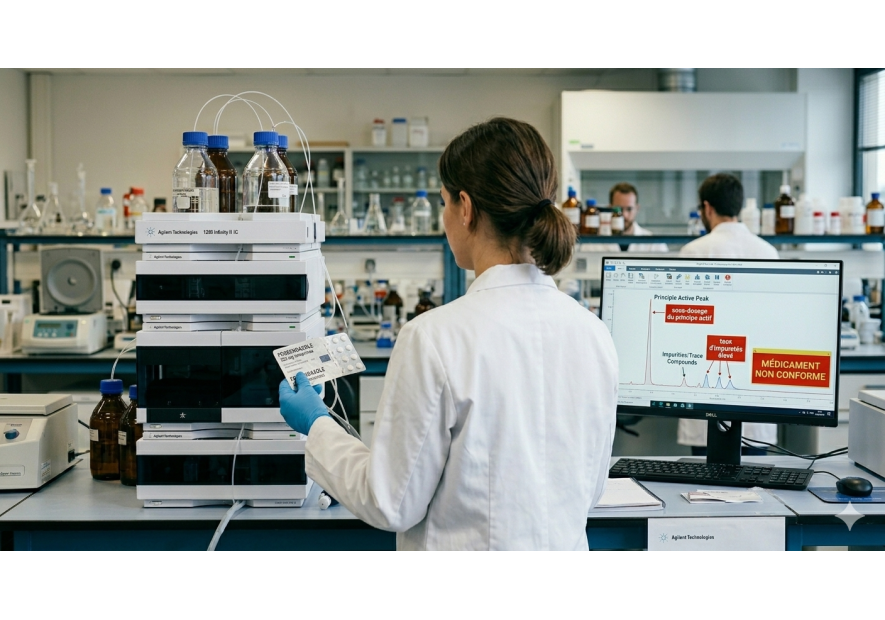
In the field of animal health, fenbendazole is a mainstay of antiparasitic treatment. However, in recent years, this compound has been the subject of unprecedented media attention on social media and certain alternative health forums. Numerous posts tout the use of fenbendazole in humans, particularly as part of self-medication regimens for cancer. This trend, which completely bypasses traditional prescription channels, raises major safety concerns. In this context of uncertainty, laboratory analysis of fenbendazole becomes an indispensable tool for anyone wishing to verify the purity and dosage of a product obtained outside regulated channels.
What is fenbendazole?
Fenbendazole belongs to the benzimidazole family, a class of broad-spectrum anthelmintics.
Veterinary use and target
Unlike albendazole or mebendazole, which have marketing authorizations (MA) for human use, fenbendazole is strictly reserved for veterinary use. It is used to treat infections caused by roundworms (nematodes) and certain flatworms in cattle, horses, dogs, and cats.
Mechanism of action
The active ingredient works by binding to tubulin, a structural protein in the parasite. This binding prevents the polymerization of microtubules, thereby disrupting glucose transport and the parasite’s energy metabolism, which leads to its death.
The "Fenbendazole and Cancer" Phenomenon: A Scientific Gap
Since certain isolated testimonials went viral (notably the "Joe Tippens protocol"), fenbendazole has been touted as a miracle drug for various cancers (lung, pancreatic, colorectal). It is imperative to set the record straight.
Lack of clinical studies
To date, no regulatory clinical trials have been conducted in humans to validate the efficacy of fenbendazole in the treatment of cancer. The evidence presented is based exclusively on:
- In vitro studies (in Petri dishes).
- Studies using mouse models.
- Anecdotal reports without strict medical oversight.
Human toxicity risks
The transition from cell-based studies to human applications is complex. Fenbendazole, although well tolerated by animals, can cause severe liver toxicity, gastrointestinal disturbances, and bone marrow suppression in humans.
Self-medication without medical supervision carries the risk of dangerous drug interactions, particularly with conventional chemotherapy. A laboratory analysis of fenbendazole does not in any way validate its therapeutic use in humans; it serves solely to quantify the product in order to limit the risk of accidental overdose.
The major risks of uncontrolled purchasing channels
Since fenbendazole is a veterinary drug, it is often purchased from dubious websites, peer-to-peer marketplaces, or in the form of "raw chemical" powder (bulk powder). These channels pose serious health risks.
The problem of underdosing and impurities
Laboratory analysis of fenbendazole consistently reveals significant discrepancies between the label and the actual product.
Underdosing: The product contains less active ingredient than expected, which is particularly problematic if the user bases their "protocol" on specific doses.
Contaminants: Powders sold as “99% pure” sometimes contain heavy metals (lead, arsenic) or residues of synthetic solvents from non-pharmaceutical industrial manufacturing processes.
What are the differences between standards in veterinary medicine and human medicine?
Purity: Higher tolerance for impurities in veterinary drugs and much stricter standards for human medicines (Pharmacopoeia)
Excipients: In veterinary drugs, excipients are adapted to the animal digestive system. For human medicines, certain excipients are prohibited, and some excipients may alter the action of the drug’s active ingredient;
Quality control: Regulations for veterinary medicines are less strict than for human medicines, which are subject to strict controls validated by health authorities (ANSM/FDA).
Laboratory testing for fenbendazole is therefore the only way to determine whether the product contains any toxic substances added by unscrupulous suppliers.
Pharmanalyse: HPLC-UV expertise promoting transparency
In response to the lack of transparency among online sellers, Pharmanalyse offers a solution based on technical expertise. We use High-Performance Liquid Chromatography (HPLC-UV), the global gold standard for certifying active ingredients.
Why perform a laboratory test for fenbendazole?
Only laboratory analysis can confirm the identity of an active pharmaceutical ingredient and quantify its concentration in a medication. Color tests or certificates provided by the sellers themselves are often falsified or outdated.
The Pharmanalyse protocol guarantees:
- Formal identification: Confirmation that the powder is indeed fenbendazole and not a similar compound.
- Exact quantification: Determination of the actual purity to the nearest milligram.
- Detection of impurities: Identification of interference peaks that may indicate the presence of harmful substances.
While research on benzimidazoles and cancer is an interesting topic of academic study, the practice of self-medicating with veterinary products poses a real danger. Safety cannot be based on rumors. Laboratory analysis of fenbendazole using HPLC-UV is the only way to provide scientific evidence regarding the nature and concentration of products circulating outside official channels.
Check My Med - Participatory Science Check My Med - Participatory Science
Join Pharmanalyse in the fight against counterfeit and illegal drugs! Order our drug analysis and contribute to knowledge about the quality of medicines on the market. Our laboratory analyzes your drug, studies the data and publishes the results in a summary report accessible to the public....
Price €49.00

Fenbendazole - Panacur - Fenben - Safe Guard - Fenbenol - Fenbex Analysis Fenbendazole - Panacur - Fenben - Safe Guard - Fenbenol - Fenbex Analysis
Laboratory drug analysis to confirm the presence of fenbendazole and measure the amount of fenbendazole. The level of uncertainty in the fenbendazole content analysis depends on the selected specification (Standard <20%, Precise <10%, or Regulatory <5%). Follow the instructions to send...
Price €199.00
Leave a comment