
Laboratory analysis of albendazole: a necessity in light of public health challenges
In the global pharmaceutical landscape of 2026, the circulation of substandard or counterfeit medicines remains a major challenge for health authorities and patients. Among the most essential—yet also the most vulnerable to non-compliance—medicines, albendazole plays a central role. Whether in mass deworming programs or individual treatments for severe larval infections, the actual concentration of the active ingredient is the only guarantee of therapeutic success. This is where laboratory analysis of albendazole comes into play, serving as the sole safeguard against the ineffectiveness of underdosed treatments.
What is albendazole?
Albendazole is a benzimidazole derivative, a leading class of drugs used to treat helminthiasis (worm infections). Its versatility and extremely broad spectrum of activity make it a mainstay of tropical and veterinary medicine, as well as a common treatment in temperate countries for more "common" parasites.
Biochemical mechanism of action
The efficacy of albendazole is based on a specific molecular interaction. It inhibits the polymerization of the parasite's beta-tubulin. By preventing the formation of microtubules, the drug blocks the parasite's absorption of glucose, depleting its glycogen reserves and causing it to die of starvation.
Its chemical structure allows it to be metabolized by the liver into albendazole sulfoxide. It is this active metabolite that circulates in the bloodstream and enables the drug to reach parasites located outside the digestive tract, particularly in muscle tissue or the brain.
Dosage and clinical indications
Albendazole is prescribed according to two main regimens:
- Intestinal infections (pinworm infection, roundworm infection): Generally a single dose of 400 mg for adults.
- Systemic infections (echinococcosis, neurocysticercosis): Higher doses (often 15 mg/kg/day) administered over several cycles lasting several weeks.
In these lengthy and complex treatment regimens, laboratory testing for albendazole is all the more important, as a failure to administer the correct dose over several weeks can have serious consequences for the patient’s survival.
The risks of taking an underdosed course of albendazole
The issue of underdosing in medications sold online or through informal channels is not merely a manufacturing error; it is a major health risk. Using a product without first having it tested for albendazole in a laboratory exposes users to dangers that are often invisible to the naked eye.
The failure of mass treatments and serious medical conditions
For diseases such as neurocysticercosis (tapeworm larvae in the brain), the dosage must be precise to ensure that a sufficient concentration crosses the blood-brain barrier. A medication containing only 60% or 80% of the stated dose will not kill the larvae, but may cause chronic inflammation or worsen neurological symptoms without resolving the infection.
The specter of parasitic resistance
This is the most insidious risk on a global scale. By exposing parasites to "subtherapeutic" doses, we allow the most resistant individuals to survive and reproduce. By 2026, the emergence of benzimidazole-resistant hookworm strains is a growing concern. Under-dosing is the primary driver of this resistance, rendering future treatments ineffective for the entire community.
Presence of impurities and contaminants
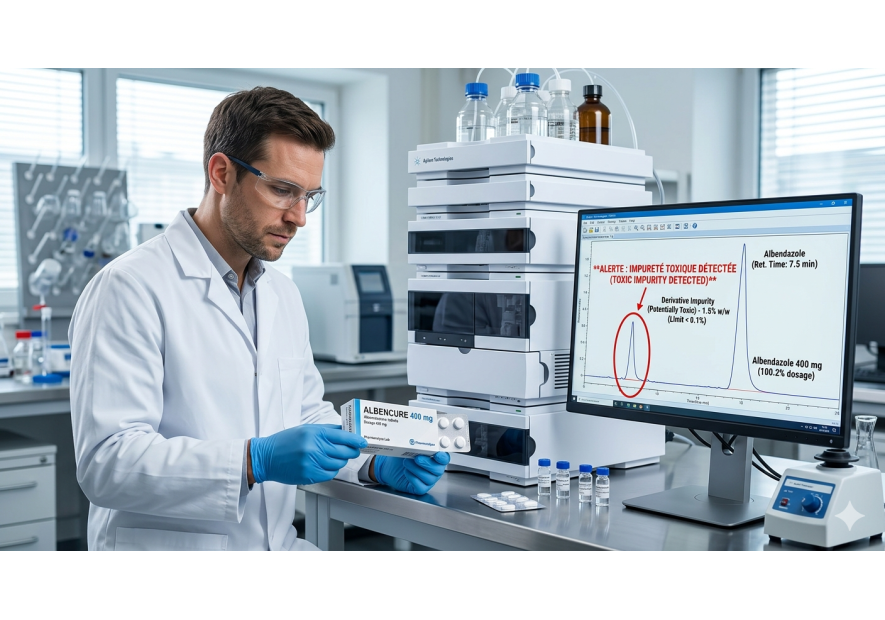
An underdosed medication is often a sign of a neglected production line. The lack of rigorous quality control means that the tablet may not only lack the active ingredient but may also contain heavy metals or synthetic impurities resulting from inadequate purification of the raw compound.
Pharmanalyse: The precision of HPLC-UV for certifying your medication
In the face of uncertainty in global markets, Pharmanalyse offers cutting-edge expertise to ensure a secure supply chain. Simple visual inspection or taste testing are outdated and dangerous methods. Only analytical science can eliminate doubt.
The HPLC-UV method: The "Gold Standard"
Pharmanalyse uses high-performance liquid chromatography coupled with an ultraviolet detector (HPLC-UV). This technique is the gold standard in the pharmaceutical industry for the laboratory analysis of albendazole.
The process is extremely rigorous:
- Molecular separation: The drug is dissolved and then injected into a silica column under high pressure. Albendazole is physically separated from its excipients and impurities.
- Selective detection: The UV detector measures the molecule’s light signature at a specific wavelength.
- Absolute quantification: By comparing the sample to a certified high-purity standard, the laboratory determines the exact mass of the active ingredient in the drug to the nearest milligram.
Why choose Pharmanalyse?
When you have our services perform a laboratory analysis of albendazole, you receive certification of the drug’s identity and quantity. In a world where medication packaging can be perfectly counterfeited, only a chemical analysis of the contents can guarantee that what you are taking matches what your doctor prescribed.
The precision of our equipment allows us to detect not only under-dosing but also product degradation (caused by heat or humidity), thereby ensuring complete safety for the end user.
Trust is no substitute for scientific evidence. Whether you are a distributor, an NGO, or a patient, verifying the efficacy of your antiparasitic treatments is a non-negotiable step in modern public health.
Check My Med - Participatory Science Check My Med - Participatory Science
Join Pharmanalyse in the fight against counterfeit and illegal drugs! Order our drug analysis and contribute to knowledge about the quality of medicines on the market. Our laboratory analyzes your drug, studies the data and publishes the results in a summary report accessible to the public....
Price €49.00

Albendazole - Zentel - Albenza Analysis Albendazole - Zentel - Albenza Analysis
Laboratory analysis of drugs to certify the presence and measure the quantity of Albendazole. The level of uncertainty of the Albendazole content analysis depends on the declination selected (Standard <20%, Precise <10% or Regulatory <5%). Follow the instructions to send your medication...
Price €149.00
Leave a comment