
Chloroquine testing: a matter of survival in the face of malaria and counterfeit drugs
For decades, chloroquine has remained one of the most iconic treatments in the fight against malaria. However, its global prominence has made it a prime target for counterfeit drug trafficking networks. Amid stock shortages, media pressure, and parallel supply chains, chloroquine testing has become the only scientific safeguard capable of distinguishing a genuine treatment from a potentially deadly counterfeit. In a globalized market where the “real” looks almost identical to the “fake,” laboratory certification is no longer a luxury, but a vital necessity.
What is chloroquine?
Chloroquine is a compound belonging to the 4-aminoquinoline family. It is included on the WHO List of Essential Medicines due to its proven effectiveness and low production cost.
Mechanism of action
Chloroquine acts by targeting the metabolism of the Plasmodium parasite. When the parasite breaks down the host’s hemoglobin, it releases heme, a substance that is toxic to it. To survive, it converts this heme into hemozoin (a non-toxic pigment). Chloroquine interferes with this process: it binds to heme and prevents its crystallization. The accumulation of free heme eventually poisons and kills the parasite.
Dosage and Indications
Chloroquine is generally used in the form of salts (chloroquine phosphate or sulfate).
Malaria treatment: Protocols vary by region, but often involve an initial dose followed by a tapering regimen over three days.
Autoimmune diseases: At lower, chronic doses, it is used to treat systemic lupus erythematosus and rheumatoid arthritis.
What are the risks of taking counterfeit chloroquine?
The risk of failing to test for chloroquine before distributing a batch is enormous. Counterfeiting this drug is not merely a matter of commercial fraud; it silently kills through various mechanisms.
Under-dosing and resistance
This is the most common risk. A tablet containing 50 mg of active ingredient instead of the advertised 100 mg or 250 mg will not be able to eliminate all parasites. This chronic underdosing is the main driver behind the emergence of chloroquine-resistant strains of Plasmodium falciparum, rendering the drug ineffective for entire populations.
Absence of an active ingredient and substitution
In the most severe cases, the medication contains no trace of chloroquine. It is sometimes replaced with acetaminophen (to reduce fever and mislead the patient about its effectiveness) or with chalk. For patients with malaria, this lack of treatment inevitably leads to neurological complications or multi-organ failure.
Presence of impurities and toxic excipients
Clandestine laboratories often use low-quality chemical precursors. The result is a finished product laden with synthetic impurities or heavy metals. Traces of pesticides or industrial dyes—used to give the tablet its usual appearance—have sometimes been found in counterfeit batches.
Pharmanalysis: The Precision of HPLC-UV as a Solution
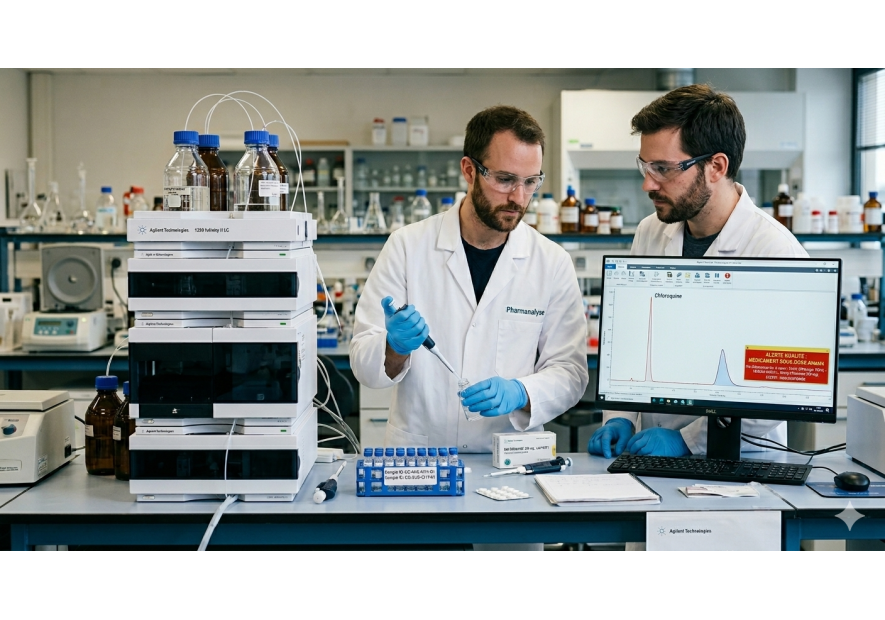
In the face of uncertainty, Pharmanalyse offers chloroquine analysis as the ultimate validation tool. Simply inspecting blister packs visually is no longer sufficient to ensure safety.
The HPLC-UV method: the gold standard in the pharmaceutical industry and quality control
We use high-performance liquid chromatography coupled with an ultraviolet detector (HPLC-UV). This is the gold standard method for the global pharmaceutical industry.
Steps and objectives of the analysis:
Chromatographic separation: Isolate the chloroquine molecule from all other components.
UV Spectrophotometry: Confirm the identity of the molecule based on its specific absorption spectrum.
Quantification: Measuring the exact concentration relative to a certified standard.
When analyzing chloroquine using HPLC, our system is capable of detecting concentration variations in the range of 1%, whereas rapid field tests can only detect rough differences.
Why use a certified laboratory?
It is crucial to understand that only laboratory analysis can verify the identity of an active pharmaceutical ingredient and quantify its presence in a drug. Certificates of conformity provided by unverified suppliers may be forged. Pharmanalyse provides scientific, impartial, and accurate evidence that is essential for NGOs, ministries of health, and private importers.
A drug whose quality has not been proven is a drug that may prove dangerous. In the case of chloroquine, the accuracy of the dosage is the difference between a cure and treatment failure.
Pharmanalyse's goal is to ensure the safety of antimalarial drugs through systematic analysis of chloroquine. This is the only way to maintain the effectiveness of this vital therapeutic tool. By choosing the precision of HPLC-UV, you are choosing science over improvisation and health risks.
Check My Med - Participatory Science Check My Med - Participatory Science
Join Pharmanalyse in the fight against counterfeit and illegal drugs! Order our drug analysis and contribute to knowledge about the quality of medicines on the market. Our laboratory analyzes your drug, studies the data and publishes the results in a summary report accessible to the public....
Price €49.00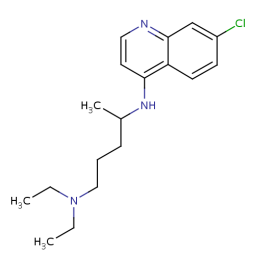

Chloroquine - Nivaquine - Resochin - Aralen Analysis Chloroquine - Nivaquine - Resochin - Aralen Analysis
Laboratory analysis of drugs to certify the presence and measure the quantity of Chloroquine. The level of uncertainty of the Chloroquine content analysis depends on the declination selected (Standard <20%, Precise <10% or Regulatory <5%). Follow the instructions to send your drug to our...
Price €149.00
Leave a comment